Product data management for eCommerce
StoreLinkr enables you to bring all your product information together with true multi-source product data management while using a fully headless PIM system that centralizes every detail for every channel.
Looking for the PIM system itself? Read what a PIM system is and what StoreLinkr does with it.
- Centralized product data hub
- AI-powered content enrichment
- Headless PIM for multi-channel sync
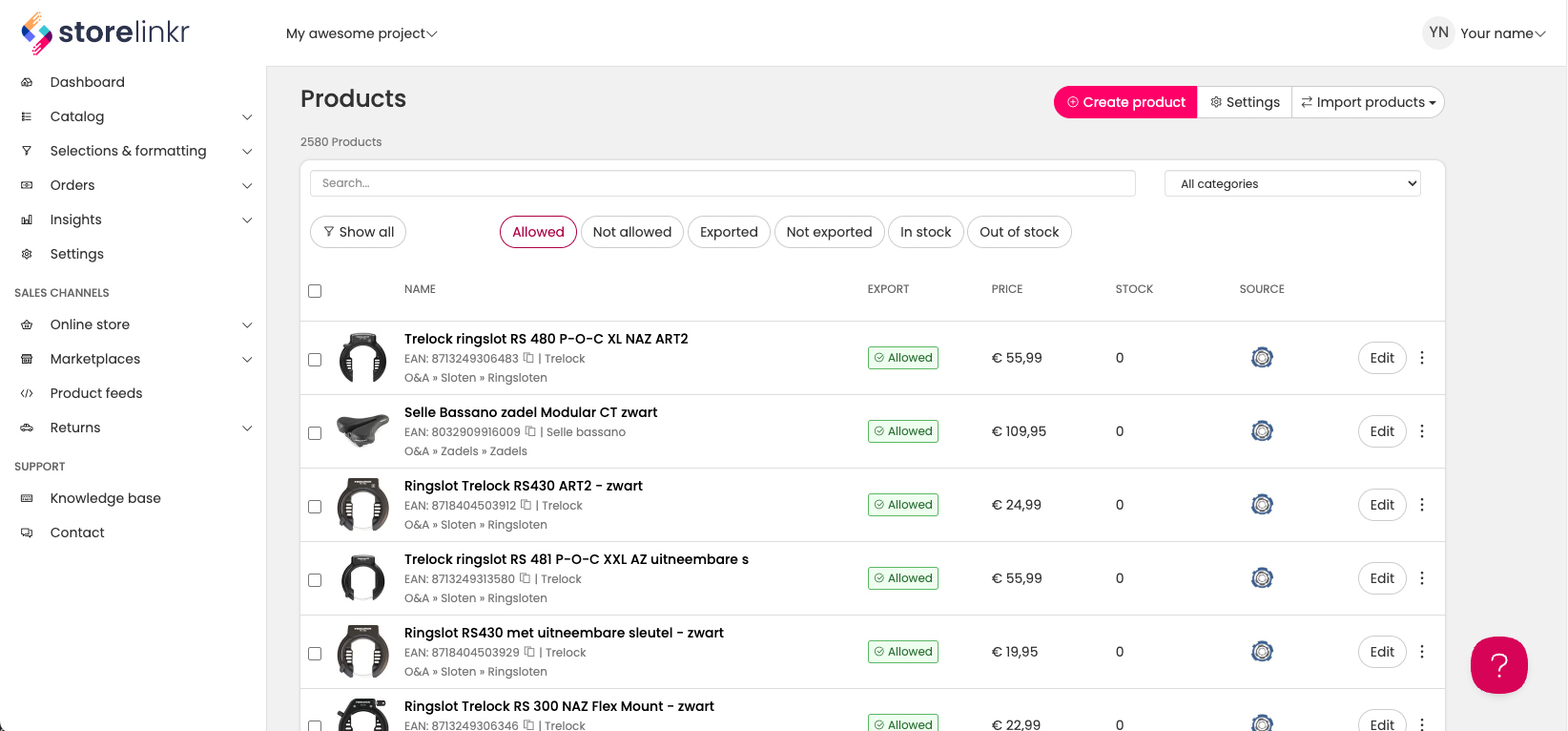
What you can do
What you can do with product data in StoreLinkr
One catalogue for every channel: import from any source, improve it once and publish the right version to each channel.
Import from many sources
Pull products from supplier feeds, your ERP, POS or webshop, or upload an Excel or CSV file once. Imported data is refreshed by the sync.
Edit in the PIM
Write descriptions, sort and exclude images, manage attributes and metafields, and link products as cross-sells, up-sells or accessories.
Product rules that stay
Override a title or description on an imported product with a rule, so your improvement is kept when the supplier updates its feed.
Enrichment in one click
Enrich a product from its EAN, with Google Books for ISBNs and your AI Agent for better text. You compare old and new values and nothing is saved until you accept.
Data quality dashboard
Issues are grouped as critical, warning or notice, such as a missing EAN or no images, and one click shows the affected products so you can fix them.
Control what is exported
Export filters keep products out of every channel, for example without images, below a minimum margin or stock, or in an excluded category.
Capabilities
Everything to keep product data clean
Feed management
Feeds per channel, updated automatically
Feed managementSmart content mapping
Map fields and categories per marketplace
Smart content mappingBulk processing
Edit thousands of products at once
Bulk processingAI product enrichment
Product data for search and AI answers
AI product enrichmentHow it works
From source to channel in four steps
-
Connect your sources
Link supplier feeds, your ERP, POS or webshop, or upload a CSV or Excel file.
-
Improve it once
Fix and enrich products in the PIM, add product rules and text formatters, and follow the data quality dashboard.
-
Choose what goes where
Map categories and set export filters and product selections for each channel.
-
Publish and stay in sync
Products, stock and prices go to every connected channel and stay up to date automatically.
 Feed: Bol
Feeds
Build the feed each channel expects
Rules decide which products go where and how titles, prices and images are shaped for that channel.
- Channel specific titles and descriptions
- Exclude products by brand, margin or stock
- Preview every feed before it goes live
Enrichment
Fill the gaps automatically
Missing images, EANs or descriptions are flagged and, where possible, completed from trusted sources.
- Data quality score per product
- Variants grouped automatically
- Text replace rules for whole catalogues
Aggregate product data from every source
True multi-source product data management
StoreLinkr consolidates product information from WMS, ERP, POS, supplier feeds, and spreadsheets into one coherent and structured dataset. This provides the foundation your headless PIM system needs to publish clean, reliable data everywhere.


Centralize all product feeds
Import product information from endless sources and merge them into a single structured dataset built for scalability, speed, and accuracy.
Automated data cleansing
StoreLinkr resolves duplicates, corrects inconsistent fields, and standardizes values so your PIM workflows always start with perfect data.
Attribute mapping across systems
Map attributes from different suppliers and systems automatically, ensuring every field aligns with your preferred structure.
Bulk editing at scale
Edit thousands of products at once without slowing down. Perfect for seasonal collections, new marketplace listings, or large catalog updates.
Powerful product structuring
Build your product catalog with a headless PIM system
StoreLinkr’s headless PIM architecture allows you to structure, enrich, version, and distribute product information across unlimited channels without being locked into a traditional monolithic system.
Flexible product modelling
Create advanced product relationships, variations, bundles, and category structures without technical constraints.
Channel-specific data layers
Create rules per marketplace or region, tailoring data for Amazon, bol, Shopify, or your D2C channels with full precision.
Versioning & history tracking
Track every change made to product data, revert instantly, and ensure compliance with internal workflows.
Lightning-fast distribution
Push complete product data to all channels in seconds-not minutes or hours.
Smart multilingual enrichment
Automate, import, and validate product translations
StoreLinkr centralizes your product translations by importing data from WMS, PIM, and ERP systems-or generating them automatically with DeepL or ChatGPT. Users can review and approve translations in their native language, ensuring accuracy at scale.
Import translations from any system
Sync translations from WMS, PIM, ERP, or supplier feeds and keep them fully aligned with your product catalog.
AI-powered translation generation
Generate high-quality translations automatically using DeepL or ChatGPT, with customizable prompts and tone settings per channel.
Human review & approval workflows
Let native-speaking team members approve translations per language, ensuring quality while keeping the process fast and reliable.
Channel-specific text optimization
Adjust translations per marketplace-Amazon, bol, Shopify, Magento, or international channels-with rules for titles, bullets, and search terms.
Data accuracy without manual work
Automated workflows for PIM governance
Intelligent automation keeps your multi-source product data management clean and consistent. StoreLinkr verifies, enriches, validates, and publishes data with minimal human input.
Automated validation rules
Ensure every product meets the requirements of each sales channel before publication.
Supplier data enrichment
Automatically enrich incomplete supplier datasets with attributes, descriptions, taxonomy, or compliance fields.
Automated attribute generation
Generate missing attributes through rule-based automation or AI-assisted content creation.
Scalable multi-channel publishing
Your product information is automatically synced across every connected storefront, marketplace, and internal system.